Tuesday, March 29, 2011

Goodies from the Garden: Grecian Windflowers (Anemone blanda)


Anemone blanda 'Blue Shades'
One of my favorite early spring bloomers are Grecian windflowers or Anemone blanda.  I am particularly fond of the 'Blue Shades' mixture.  They bloom early in the spring usually starting in the first or second week of March and continuing easily for almost two months, when our hot weather begins to set in.  I think this fall I will try over-planting a patch of dwarf daffodils, Narcissus 'Tete-a-tete', with some 'Blue Shades' windflowers.

Windflowers can be purchased from many of the major bulb companies and planted in the fall when other fall-planted bulbs are planted.  I have found that like their large cousins, Anemone coronaria, I am most successful with windflowers when I soak their dime-sized tubers overnight before planting.  They are easy to poke in wherever you want them.  Just push your finger into the soil about 2 inches deep and pop it in.  Plant them in an area where they can naturalize and form a mat and you will be greeted with the cheerful blooms throughout the spring.  Hardy in zones 4-8.

Check it out:


    Monday, March 21, 2011

    Fave Plant Rant: Edgeworthia chrysantha

    Edgeworthia gardneri
    Scientific Name:  Edgeworthia chrysantha (syn.:  Edgeworthia papyrifera), Edgeworthia gardneri

    Common Name:  Oriental Paperbush, Indian Paperbush

    Family:   Thymelaeaceae


    This is the first in a new series on entries for Horticouture.  People always ask me what my favorite plant is.  Well, that's like choosing your favorite child (more difficult for some mothers than others).  So, the "Fave Plant Rants" will showcase the plants that I would devote a place in my garden to if I had a limited amount of space.  

    Saturday, March 19, 2011

    Welcome to the launch of Horticouture!

    Consider it a new beginning, a rebirth, or a pathetic second attempt at blogging.  Horticouture is the new and improved reincarnation of my previous blog of several years ago (Hortus odorifera).  I've uploaded a few posts from the old blog that are still relevant.  Enjoy!

    Oh an please feel free to send me your feedback.  I would love to hear what you have to say!

    Wednesday, March 19, 2008

    Spring Fragrance


    Excuses about not blogging for a long time aside (blah blah blah....right?) I've decided to get this going again. Third time's the charm right? Aside from perfume news and reviews, which are still to come, I wanted to start up a new spring series about fragrant plants for the garden. As spring quickly approaches the weather becomes unpredictable, birds build their nests, and there's an explosion of color and scent in the garden. Although many spring flowers do not have a scent, there are usually varieties that do indeed have the added dimension of fragrance. In fact some of the most legendary and expensive ingredients in perfume come from spring flowers, while others are relatively unknown to most.

    (Photo above: Narcissus 'Brackenhurst' at the US Botanic Garden -- not a significantly fragrant daffodil, but a great early show-stopper)


    1) Narcissus x odorus flore pleno (Double Campernelle Daffodil, Queen Anne's Double Jonquil)

    The Campernelles are some of my favorite daffodils when considering fragrance. Anyone interested in scent in the garden needs to have at least a clump of them. One of the earliest daffodils to pop up in the spring, they started blooming here in Washington, DC in the second week of March. The are about 10 to 12 inches tall and the golden yellow flower can vary from a double cup to a yellow rose shape with many flowers on one stem. It's great to cut a few of them to put them in a vase and bring them indoors where you can really savor their sweet scent of honeyed musk. You really can't beat them.

    Available from: Brent & Becky's Bulbs, Colorblends

    2) Mahonia aquifolium (Oregon-Grape)

    This relative of the hollies starts to bloom extremely early in the spring in Washington, DC (this year as early as early February) and they continue to bloom for a long period of time as long as the weather remains cool. The shrubs can be otherwise rather coarse in texture, but the flowers are their truly redeeming quality. The flowers have a sweet fragrance that is reminiscent of jasmine and lemon. It has a sugary tang to it and I personally cannot walk by a Mahonia without plunging my nose into one of the panicles of flowers.

    3) Narcissus 'Carlton' (Carlton Daffodil)

    Carlton is one of the most common daffodils and the quintessential daffodil that is the first to come to mind. It' s a great perennializer, especially in southern gardens. It's a large-cupped canary yellow daffodil that blooms early and profusely. Carlton is truly a sign that spring has arrived. This is the daffodil that lines highways and you find growing on old homesteads long after the homes gone. It's also the daffodil that you find in your grocery stores and sold by the American Cancer Society during Daffodil Days. It also has a slight fragrance as well, which is much softer compared to the Campernelles, but still worth mentioning. It has a warm vanilla sugar scent. Place a vase of unopened Carlton buds on a table in your house and by morning you'll have a vase of glowing daffodils fully opened and a wonderfully-scented room.

    Available from: Brent & Becky's Bulbs, McClure & Zimmerman, and Colorblends


    Many more to come!

    Saturday, October 20, 2007

    My Own Sugar Scrub Recipe

    I've decided to post my sugar scrub recipe. It's extremely simple, but very effective. You should note that it is only really appropriate for body exfoliation. It's too rough for the face. The recipe is not a science and it is really up to you to determine the relative amounts of ingredients. The ingredients are:

    Turbinado Sugar (coarse organic sugar)
    Light Brown Sugar
    Carrier Oils (I prefer Vitamin E-enriched Sweet Almond Oil)
    Essential oils

    Now a few tricks to it. I usually make it fairly concentrated. It lasts longer this way and dilutes when you use it in the shower. There's no exact amount of essential oils to use. You usually only need about 4 or 5 drops of essential oil per 1 ounce of the carrier oil, but I find that adding more increases the fragrance and aromatherapy effect of the scrub. Use whatever oils you like, but my personal favorite is a combination of lemon (Citrus limon) and lavender (Lavendula angustifolia). You can formulate your scrub to treat a variety of skin ailments, for example acne can be treated with the essential oils of lavender, neroli, tea tree, clove bud, cedarwood, rosemary, and many others. This information is readily available online and many essential oils as well as the rest of the ingredients are available at organic markets, health stores, and any other purveyor of botanical health products. In Washington, DC area Whole Foods and Mom's Organic Markets carry a broad range of the ingredients. Of course, use organic ingredients when possible.

    I usually use about 5 ounces of the carrier oil, to which I add about 30-40 drops of essential oils (of the desired blends). I then add both grades of sugar in equal proportions and keep stirring the mixture until I reach the desired consistency. I prefer a thick, but moist mixture that doesn't appear runny, but this is just a personal preference.

    The scrub usually works best after you've used your soap and while you are standing in a hot shower. Using it after showering helps to return your skin to its preferred pH range and leaves more of the fragrance of the EO's on the skin. Be sure to store the scrub in an air/water-tight container and use some sort of scoop or spoon when using (the bacteria on your hands can speed the decomposition of the scrub mixture).

    Monday, October 15, 2007

    Hermessence Brin de Réglisse - New Fragrance


    Jean-Claude Ellena's newest creation for Hermés, Brin de Réglisse is the newest (and 7th) addition to the Hermessence line. On the heels of such beautiful creations as Paprika Brasil and Osmanthe Yunnan, Brin de Réglisse is said to be an atypical lavender perfume that is not overpowered by being combined with heady florals, but instead Ellena tried to create a drier, cleaner lavender fragrance. He was inspired by the strong scent of lavender one would smell in Provence in midsummer. Ellena said he wanted a more clean, stream-lined lavender fragrance. Other notes include orange blossom, hay, and licorice (hence the name Brin de Réglisse, or "a bit of liquorice"). Like the other Hermessence fragrances, they will only be available at Hermés boutiques and will cost 149 euros (about $211.00) for a 100 mL bottle. I'm not sure exactly on the US price, but that I will update this post as soon as I know the exact cost. Hermessence fragrances can also be purchased in sets of four 15 mL vials for 95 euros (about $135.00), for which you may select four of the same fragrance or any combination of the seven Hermessence fragrances. None the less I suggest you visit your nearest boutique and check it out. If you are in the D.C. area, the local Hermès boutique is located in the Fairfax Square Shopping Center in Vienna, Virginia. (They are usually quite generous with samples as well)

    Saturday, July 21, 2007

    Books You Need to Read....

    There are three books that I've read lately that I feel I need to share. For all of you true fragrance freaks like me they are your required summer reading.


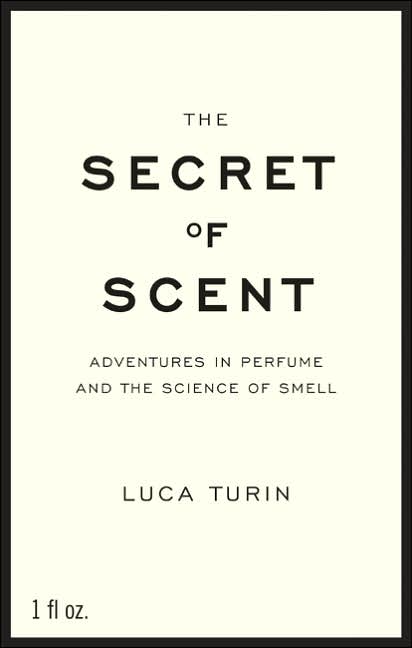
    The first is the Secret of Scent by fragrance biophysicist Luca Turin. Luca Turin began writing perfume reviews almost on a whim many years ago in Paris. Always a sucker for any random tidbit of information he could get his hands on he started uncovering some discrepancies in the way the scientific world looks at the sense of smell. Through much thorough research and a lot of stone-throwing from the scientific community, Turin has reintroduced and expanded upon theories of a vibrational mechanism for the sense of smell. The book explains a bit of his background and the story of how he made his contribution to the theory and explains the theory in a fair amount of detail. It can be quite dense if you don't have much of a science background, but it's a good read nonetheless. The Secret of Scent by Luca Turin is available from Barnes & Noble for $23.95.

    Secondly, the Emperor of Scent by New York Times Perfume Critic Chandler Burr. Burr met Turin by chance in a railway terminal several years ago. After much small talk, they struck up a conversation about Turin's work with smell. Burr was interested and as a reporter investigated the theory and Turin's story. Unfortunately, Turin's adversaries were unwilling to give their side of the story, so Burr's book is mostly a chronicle of Turin's story. A worthy companion to Turin's book, it should not be overlooked just because one has also read the Secret of Scent. The Emperor of Scent by Chandler Burr is available from Barnes & Noble for $13.95.


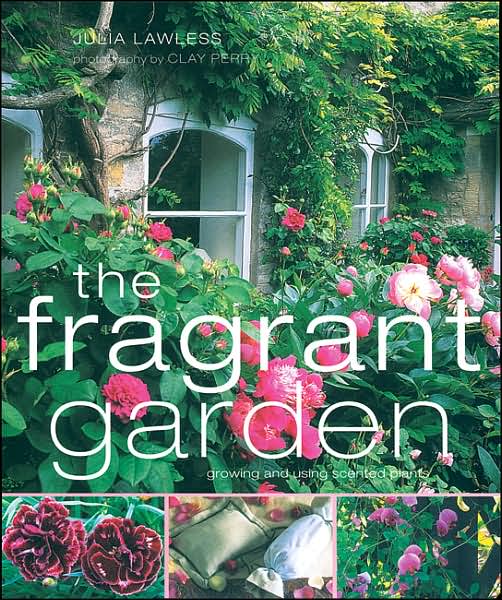
    The last is The Fragrant Garden by Julia Lawless. The books is a great read for anyone interested in Gardner and/or perfume and fragrance. It includes many sections with widely varying topics. It's not just and encyclopedia of fragrant plants which a lot of fragrance gardening books are, but it includes much history about the history of fragrant gardening, exotic as well as domestic plants, information about essential oils and aromatherapy, and even some recipes and advice for the use of fragrant herbs. A great read for anyone who is interested in this blog. It is available from Barnes and Noble for $27.50.